The Padel Boom: Why London’s Fastest-Growing Sport Faces a Grassroots Gap
New research exposes the UK's Grassroots Gap behind Britain's fastest-growing sport
15 September 2026 · 6 min read
Padel is the fastest-growing racket sport Britain has ever seen, with LTA figures showing the number of people playing has rocketed from just 15,000 in 2019 to one million in May 2026, across 1,825 courts and 551 venues.
The International Padel Federation has made Olympic recognition and grassroots-to-professional development major priorities for the sport, but new research from PDH Sports suggests the sport's popularity is running well ahead of the infrastructure, pricing and public investment needed to sustain it, or to meet the IPF’s lofty goals.
The Demand vs Ability to Supply
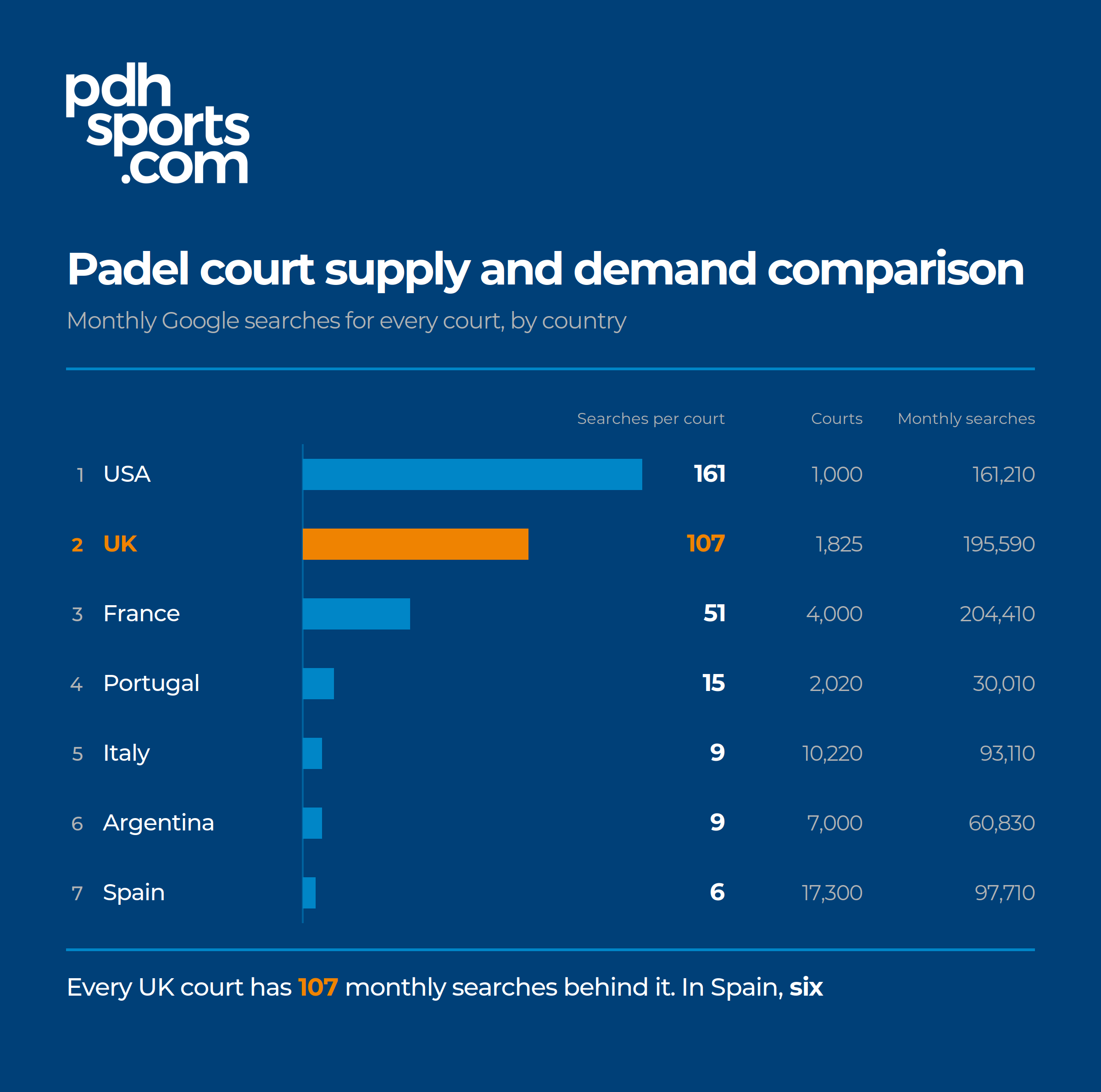
The research points to a clear supply-demand mismatch in the UK. Demand for padel courts across the country is currently outstripping supply, and the UK ranks second only to the United States for the sheer volume of searches per available court - a significant signal of just how much unmet appetite for the sport exists across the UK.
A substantial expansion of infrastructure is required in order for the UK to compete on a global scale.
The UK currently faces an estimated deficit of nearly 33,000 courts when compared to neighbouring European countries like Spain - which has officially recognised the sport since the early 90s - and will need to build roughly 19 times its existing capacity to match the global benchmark set by Spain's court-to-population ratio.
Based on current construction rates, the research from PDH Sports indicates that the UK is not on track to bridge this gap until 2031.
The Financial Barriers
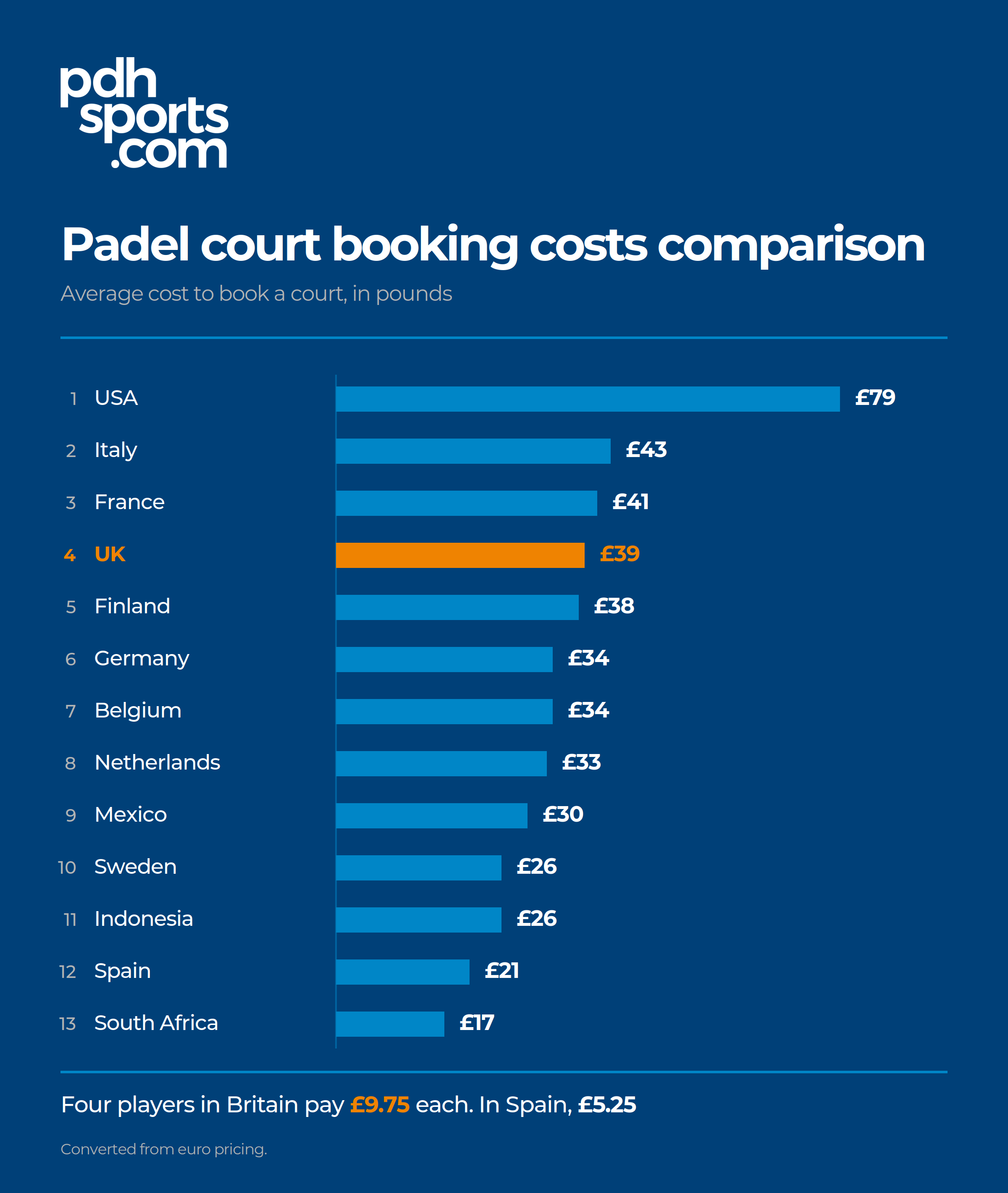
At an average of £39 per court booking, the UK has the fourth-highest padel court prices of the thirteen international markets analysed, and the third-highest in Europe.
The UK sits behind only Italy and France, and ahead of Finland, Germany and Belgium , the Netherlands, Sweden and, notably, Spain - the sport's world leader in participation.
The fact that competitive padel's birthplace provides court rentals at about half the price found in the UK implies that achieving scale, rather than relying on scarcity pricing, represents the viable path toward reduction.
The Investment Gap
Padel was completely omitted from the government's flagship £125 million Multi-Sport Grassroots Facilities Programme (2024/25), with funding directed almost exclusively through the Football Foundation.
Meanwhile, Sport England's own grant data for 2020-2025 shows that padel received just £7.69 million - £7.5m funnelled from the LTA’s own grants and £193,191 directly to grassroots clubs - the lowest total public funding of the four racket sports compared.
The funding allocation per player presents a different picture though. The Active Lives Survey from Sport England puts padel’s player numbers at almost 280,000, making padel's grant of £28.41 per participant is more than three times that of tennis (£7.93), and more than four times that of badminton (£6.64).
However, the LTA says player figures for padel hit 1 million in May 2026, making the grant per player in line with that of Tennis (£7.96) instead - a figure that will only decrease in line with the rapid growth in popularity of the sport.
The Regional Investment in Racket Sports
Racket sports funding across the UK is glaringly unequal, and it’s not London leading the way. Just three regions, the South East, London, and the North West, see £64.7 million of the total £75.04 million distributed across 1,520 grants.
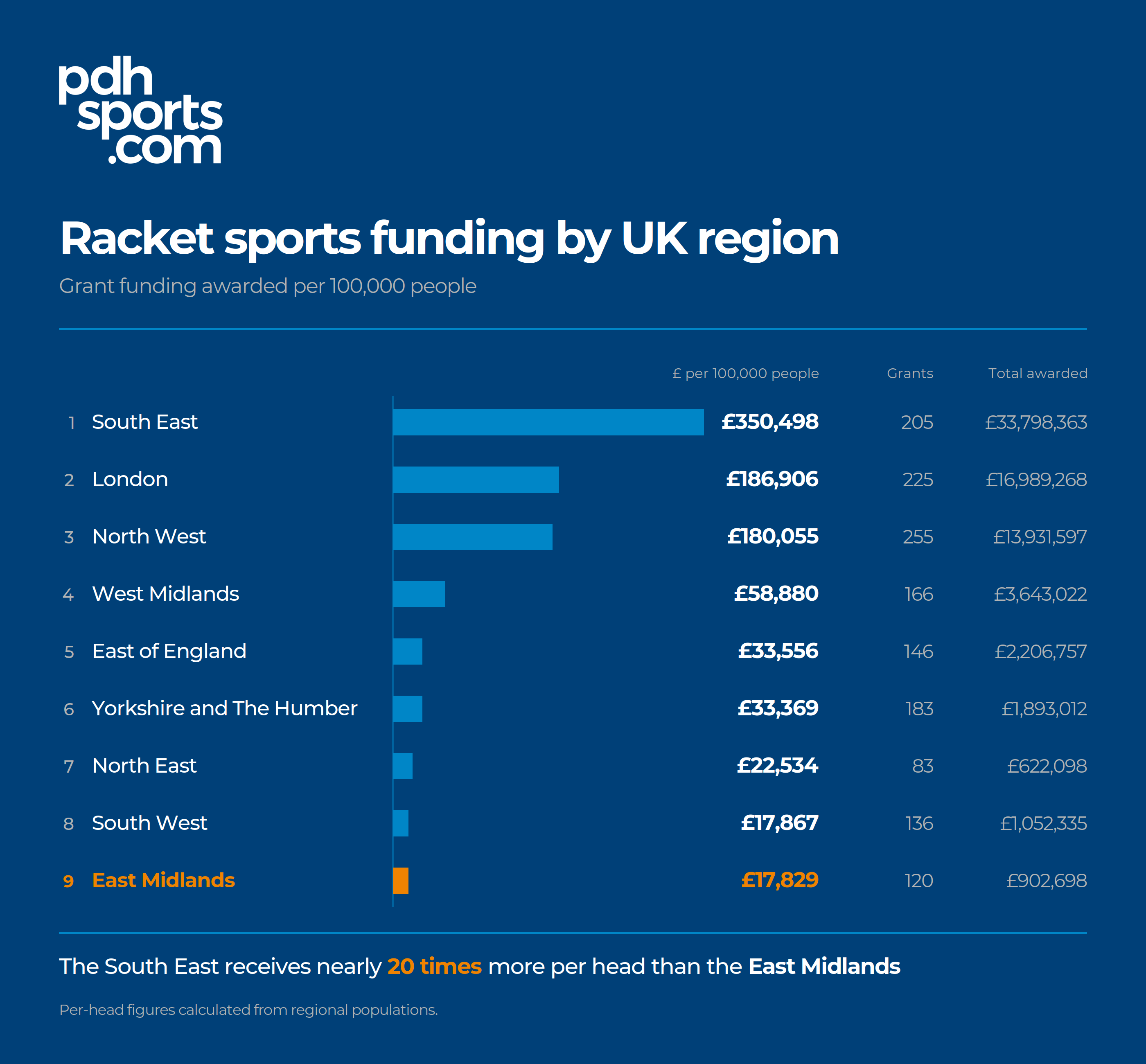
A staggering 86% of all funding goes to under a third of the country's regions, and the imbalance is even more dramatic on a per-person basis:
Top Tier: The South East leads by a huge margin with £350,498 per 100,000 people (approx. £3.50 per head) - nearly double London (£186,906) and the North West (£180,055), which both receive around £1.80–£1.90 per head
Mid Tier: The South East gets over six times as much per capita as the West Midlands (£58,880 per 100k, or £0.59 per head). Meanwhile, the East of England and Yorkshire & Humber sit in the middle tier at roughly £33,000–£33,500 per 100k (~33p per head)
Bottom Tier: The North East, South West, and East Midlands represent the lowest tier in England, grouped tightly between £17,800 and £22,500 per 100k (just 18p–23p per head)
Beyond securing a higher volume of awards, the South East also secures significantly larger individual grants. At an average of £164,870 per grant, funding in the South East is more than double London's £75,508 average and triple the North West's £54,634.
Every remaining region averages under £22,000 per grant, with the North East, South West, and East Midlands receiving just £7,500–£7,700 on average — meaning grassroots funding in these regions is both far less frequent and far smaller in scale.
The analysis also shows that public funding for racket sports is distributed far more unevenly than the sport itself.
Of the 485 padel clubs across England, it’s no surprise that London has the most clubs for its population, at 10.8 per million people, and the North East has the fewest at 5.1 - a gap of roughly two to one. But the grant funding doesn’t match up - the gap is nearly twenty to one.
The findings from the report suggest padel's growth outside the South East has happened largely without public support, driven instead by private operators and by clubs converting existing courts.
The Professional Opportunities & The Olympic Dream
The exploding popularity of the sport is also evident among younger players, highlighted by the 2025 UK Padel National Schools U18 Championships, which drew a record field of 132 participants to mark its largest turnout ever.
However, career prospects at the professional level within the sport remain limited. Out of 198 athletes currently holding spots in the world professional padel rankings across 16 nations, only two are from Britain compared to 128 representing Spain and 33 from Argentina. This disparity clearly highlights the lack of a structured developmental pathway connecting grassroots play to the professional ranks in the UK.
The case for reform is reinforced by how the current system spends its money elsewhere. Thirteen of the thirty-four disciplines funded by UK Sport have delivered no medals, and badminton - which delivered a single bronze medal in 2016 - has the second-highest cost per medal of any funded sport, at just over £15.1 million.
Padel, by contrast, already generates an estimated £11.1 million a year in UK tournament prize money alone - more than half of badminton's £16.7 million and nearly double squash's £6.7 million - despite having no formal UK Sport programme, no Olympic recognition yet, and a fraction of the public investment.
Peter Mills, Sales Director at PDHsports.com says: “If you watch most major padel events, semi or event quarter finals of P1s are pretty much exclusively made up of Spanish or Argentinian players. The challenge for the UK will be to build a base of players, facilities and coaches who can deliver the level to compete with the top players.
“A lot of countries have attributed success at a professional level to making sports part of school curriculum. Look at French badminton, three individual World champions plus World team championships runners up in 2026 – 10 years ago they certainly wouldn’t have been considered as the international powerhouse they are now!
“GB have shown they can compete at the top levels but building a network, programme and opportunities for young players to develop their padel skills from a young age will be key to producing a programme that can repeatedly deliver in years to come.”
Read the Grassroots Gap Report now at PDHSports.com
Contributor at The London News