The Psychedelic Paradox: Why London Leads in Brain Science But Lags in Patient Care
Unregulated retreats and predatory marketing are rising in London as patients struggle to find verified clinical psychedelic and ketamine therapy. Learn more.

17 November 2026 · 3 min read
London has established itself as one of the world's leading cities for neuroscientific discoveries ranging from pioneering brain-imaging protocols at Imperial College London's Centre for Psychedelic Research, psychiatric drug development at King's College London, and innovative clinical trials being run by research organizations like Clerkenwell Health. The capital is a big player in the international discourse on modern neuropsychiatric intervention. With regular herald breakthroughs released in Academic publications about psilocybin, DMT, and MDMA being used to treat psychiatric disorders, which is generating mass public attention.
Despite all of the positive headlines there is an acute disconnect from the public who can read about the amazing effects that Psychedelic medication could have for them, but no way to access them. This gives the UK a massive separation from the cutting edge work being talked about and the real outpatient therapeutic access that is available.
The main driving factor for this disparity is the complex regulatory framework with well known Psychedelic compounds like psilocybin, LSD, and MDMA categorised as Schedule 1 controlled substances under the UK Misuse of Drugs Regulations 2001. This means they are designated as drugs having no recognized medicinal therapeutic value. This means real Clinical use is basically Impossible outside of licensed academic research.
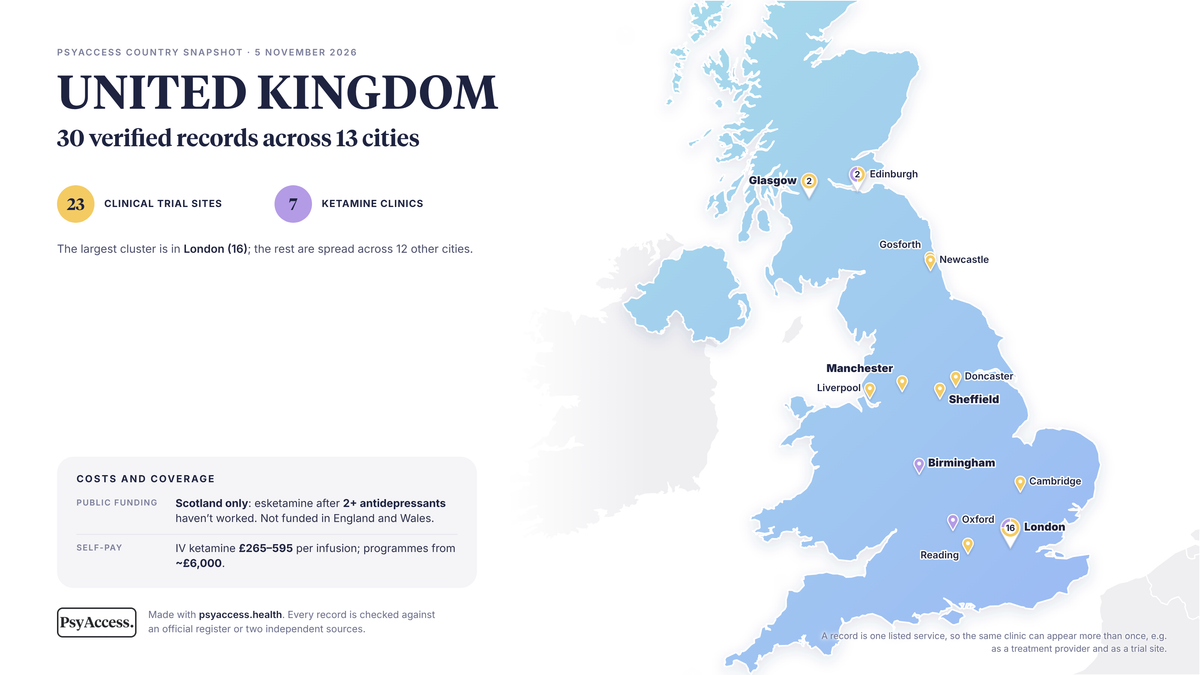
There is even confusion on a regional level for licensed avenues available through mainstream healthcare. With National Institute for Health and Care Excellence in England rejecting funding for Esketamine nasal spray (Spravato®) due to cost-effectiveness and perceived clinical uncertainties despite Esketamine nasal spray (Spravato®) gaining authorization by both the European Medicines Agency and the Medicines and Healthcare products Regulatory Agency. On the other hand the Scottish Medicines Consortium has approved restricted use within NHS Scotland. This means Londoners have to go private as their only avenue to access this treatment.
"The scientific leadership coming out of London universities is second to none, but translational infrastructure has faced enormous regulatory drag," explains Dr. Rayyan Zafar, Neuropsychopharmacologist and Postdoctoral Researcher at Imperial College London. "Patients read about revolutionary psilocybin or DMT outcomes in major academic publications, only to find that outside of highly competitive clinical trial enrollment, licensed medical avenues in the UK remain almost exclusively bound to ketamine derivatives."
Data from the newly launched PsyAccess, an open-access platform that tracks clinical delivery frameworks and verified providers. Its data highlights the scale of the United Kingdom limited approved providers across the European continent, 129 designated trial sites operate within specific investigational boundaries, leaving 358 care providers delivering stabilized outpatient interventions. Globally, out of 487 verified records across 27 countries, the United Kingdom accounts for just 29 verified providers.
With a lack of verified outpatient care and strong communication on what is available to the public a fertile ground for predatory wellness marketing and unregulated supply is created. Without clear guidance, misinformed patients frequently fall prey to unaccredited practitioners, underground retreats, and commercial operators offering unverified treatments without clinical oversight or necessary emergency protocols.
"Navigating private care requires extreme care because private provision must never outpace standard clinical ethics," notes Tom McDonald, Chief Executive Officer at Clerkenwell Health. "Patients seeking interventions for severe mental health conditions need definitive transparency regarding clinic accreditations, standard operating procedures, and long-term psychological integration support. Clinical validation cannot be compromised for commercial speed."
There is a need for more transparency on standards and statutory regulations to protect patients from substandard and deceptive providers. Open-access registries like PsyAccess that apply rigorous criteria to confirm provider legitimacy. This means every UK provider that is listed has gone through multi-source validation which includes statutory registration with the Care Quality Commission, verified medical leadership, transparent pricing structures, and structured psychotherapy integration support.
As London continues to drive academic research into novel neuropsychiatric medicines, closing the gap between experimental breakthroughs and real patient access remains the long team challenge. Improved patient access to strict clinical verification will ensure that individuals can distinguish credible medical interventions from unregulated claims.
Contributor at The London News