Get your HGV License with HGVAcademy.com
UK's leading trading provider
13 September 2026 · 5 min read
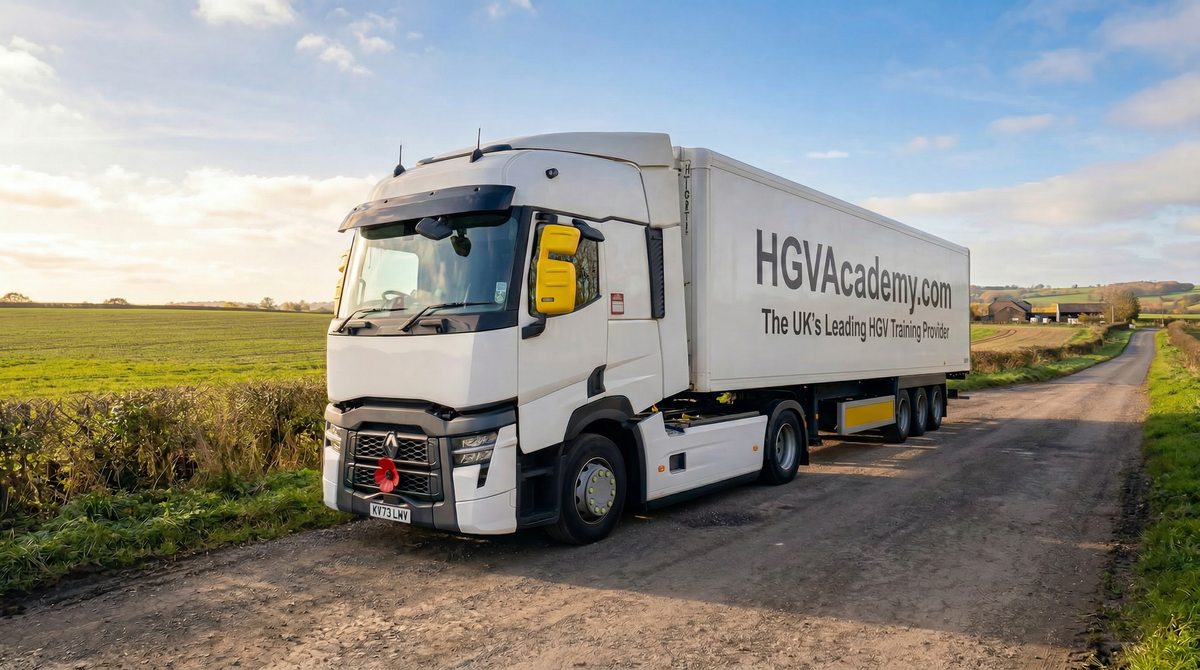
How to Get Your HGV Licence in the UK: A Step-by-Step Guide
If you’re considering a career as an HGV driver, getting your licence can open the door to a wide range of driving jobs across the UK. Whether you want to drive rigid trucks, articulated lorries or eventually move into specialist transport, the process starts with choosing the right licence category and completing the required training and tests.
Here’s a straightforward guide to getting your HGV licence, including how HGV Academy can help you through the process.
What is an HGV licence?
HGV stands for Heavy Goods Vehicle. In the UK, the licence category you need depends on the type and weight of vehicle you want to drive.
The two categories most new HGV drivers consider are:
Class 2 (Category C): Allows you to drive rigid HGVs over 3,500kg.
Class 1 (Category C+E): Allows you to drive a Category C vehicle with a trailer, including articulated lorries.
If you're starting from a standard car licence, you can work towards either route. Many drivers choose to qualify for Class 2 first and then upgrade to Class 1, while others train directly towards Class 1.
1. Make sure you meet the basic requirements
To become an HGV driver, you generally need to hold a full car licence and be at least 18. If you're going to drive an HGV as the main part of your job, you'll also need the appropriate professional Driver CPC qualification.
You'll also need to meet the relevant medical and eyesight standards for professional HGV drivers.
2. Apply for your provisional HGV entitlement
The next step is applying for the appropriate provisional entitlement through the DVLA.
You'll need:
A D2 application form
A D4 medical examination report
Your driving licence
The D4 must be completed by a doctor, and the application itself has no DVLA fee. GOV.UK says you should normally receive the licence within around three weeks of DVLA receiving your application, although it can take longer if additional checks are required.
This is one of the first areas where a good training provider can make the process much easier.
3. Complete your HGV medical
The HGV medical checks that you're fit to drive a large commercial vehicle.
With HGV Academy, the medical is included in its training route. The company says it arranges a Group 2 medical with an approved doctor and guides students through the process.
Once you've completed the necessary paperwork and have your provisional entitlement, you can move on to the theory stage.
4. Pass your HGV theory tests
Before taking your practical HGV test, you'll need to complete the relevant theory tests.
The Driver CPC theory stage includes:
Part 1a – Multiple Choice
Part 1b – Hazard Perception
Part 2 – Case Studies
GOV.UK confirms that the multiple-choice and hazard-perception elements are part of the CPC theory process.
HGV Academy provides students with a theory preparation package and says its courses include the theory element.
Tip: Don't underestimate the theory tests. Spend time practising hazard perception and learning the specific rules and knowledge required for HGV driving rather than relying solely on your experience as a car driver.
5. Start your HGV driving training
Once you're ready, you'll begin practical training with an HGV instructor.
This is where you'll develop the skills needed to safely control a much larger vehicle, including:
Vehicle positioning
Mirrors and observation
Turning and junctions
Reversing
Manoeuvring
Coupling and uncoupling where applicable
Safe braking and speed management
Dealing with other road users
Vehicle safety checks
HGV Academy offers both Class 1 and Class 2 training, with one-to-one practical instruction at training locations around the UK.
6. Take your practical tests
After completing your training, you'll take the relevant practical tests.
For drivers qualifying for professional HGV work, the Driver CPC qualification involves several stages. GOV.UK currently describes five tests making up the full Driver CPC route for first-time qualification.
Your training provider should help you understand exactly which tests apply to your chosen licence route and get you prepared for test day.
7. Get qualified and start looking for work
Once you've successfully completed the required tests and qualifications, you can begin your career as a professional HGV driver.
HGV Academy also offers support beyond the test itself. Its website says it provides job-finding assistance for newly qualified drivers, alongside additional training such as reversing practice and refresher lessons.
That can be particularly useful if you've passed your test but don't yet have commercial driving experience.
How HGV Academy can help
If you don't want to organise every stage yourself, HGV Academy offers a packaged route through the HGV qualification process.
According to HGV Academy, its courses can include:
HGV medical
Theory preparation
Practical training
Test fees
Driver CPC
PPE
Ongoing support
It offers both Class 1 and Class 2 courses, as well as a Class 2-to-Class 1 upgrade for existing HGV drivers.

How long does it take to get an HGV licence?
The timescale varies depending on your starting point, availability of tests, the amount of training you need and whether you choose an intensive course.
If you're starting with a car licence and want to become a Class 1 driver, there are several stages to complete, so it's worth planning the process rather than simply booking a few driving lessons.
HGV Academy advertises fast-track training options and says some Class 1 courses can be completed in as little as 4–6 weeks, depending on the circumstances.
Class 1 or Class 2: Which should you choose?
Class 2 (Category C) can be a good starting point if you want to drive rigid HGVs and gain experience with larger commercial vehicles.
Class 1 (Category C+E) is the qualification for articulated lorries and can give drivers access to a wider range of long-distance and logistics roles.
If your long-term goal is to become an artic driver, it's worth comparing the cost and time of going directly to Class 1 against taking the Class 2 → Class 1 route.
Ready to start your HGV career?
Getting an HGV licence doesn't have to be complicated. The basic journey is:
Car licence → Provisional HGV entitlement → Medical → Theory tests → Practical training → Practical test/CPC → Qualified HGV driver
For the official government requirements, always check the latest information on GOV.UK, as licensing and Driver CPC rules can change.
If you'd like a course provider to guide you through the process, HGV Academy offers Class 1 and Class 2 training with locations across the UK and support from the initial application through to qualification.
Ready to get started? Build your personalised HGV course and quote with HGV Academy.
Contributor at The London News