Why Gen Z's demand for workplace privacy should make employers rethink their offices
As younger employees question the benefits of open-plan working, Mathew Moore, Marketing Director at Orega, explains why the answer isn't necessarily a return to cubicles, but giving people greater choice over where and how they work.
12 November 2026 · 4 min read
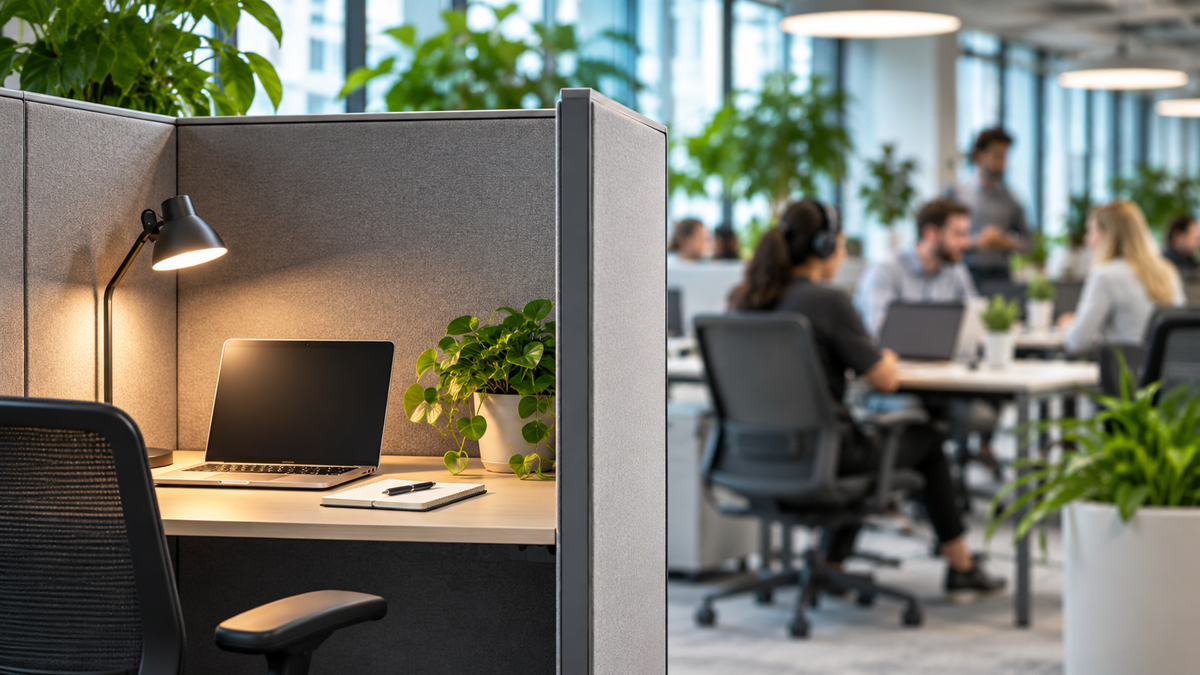
The rise of open-plan offices and hot-desking has changed the way people work, but has it come at the expense of privacy and concentration?
With younger employees increasingly questioning whether open-plan offices meet their needs, Mathew Moore, Marketing Director at Orega, discusses whether traditional office cubicles should make a comeback, the challenges of shared workspaces and why giving employees more choice over where they work could be the answer.
1. Has office etiquette changed in recent years, and is this making open-plan working more difficult?
“I wouldn’t say etiquette has gone downhill so much as the way we work has changed faster than the unwritten rules have caught up. Video calls at desks, back-to-back virtual meetings and hybrid schedules have all added noise and unpredictability to open-plan spaces that simply weren’t designed for them. The answer isn’t to blame individuals. It’s to give people the right space for the task in hand, whether that’s a quiet booth for a call, a focus area for deep work or an open space for collaboration. When people have somewhere appropriate to go, etiquette tends to take care of itself.”
2. Can the lack of personal space in open-plan offices lead to conflict between colleagues?
“Friction usually comes from a mismatch between what someone needs to do and the space they’re in, rather than from the absence of a cubicle itself. If one person is trying to concentrate while the person next to them is on a loud call, tension is almost inevitable. But walls alone don’t solve that. What reduces conflict is choice: when there are clearly defined quiet zones, phone booths and collaborative areas, people self-select the right environment and there’s far less reason to clash.”
3. Office cubicles were a familiar feature of workplaces in the 1990s. Do older generations have different expectations of privacy at work compared with younger employees?
“Every generation’s expectations are shaped by the workplaces they started in, so it’s natural that those who began their careers with a desk of their own see it differently from those who’ve only known open plan and hot desking. I don’t think it’s a case of anyone taking privacy for granted. It’s more that the need for privacy has never gone away, while many offices removed it in the name of collaboration and cost-saving. What we’re seeing now is a correction, with businesses recognising that people need both.”
4. Do you think Gen Z employees are unfairly criticised for wanting more privacy and personal space at work?
“Gen Z are sometimes unfairly characterised as wanting special treatment, but wanting a quiet place to concentrate is hardly a radical demand. Many of them started their careers during the pandemic, working from bedrooms and kitchen tables, so they’ve learned a lot about what helps them focus. Their feedback is genuinely useful to employers. In our experience, what they’re asking for isn’t isolation. It’s control over how and where they work, which is something people of every age value.”
5. What are the main benefits of traditional office cubicles?
“The cubicle’s appeal is easy to understand: fewer distractions, reduced noise, a sense of ownership over your space and a degree of visual privacy. For roles that involve a lot of concentrated work or confidential calls, those benefits are real, and it’s no surprise people are nostalgic for them.”
6. And what are the drawbacks? Is there still a place for cubicles in modern offices?
“The drawback is that a cubicle is a one-size-fits-all answer to a problem that’s really about variety. Fixed partitions can make teams feel siloed, reduce the informal conversations that help people learn, especially early in their careers, and waste space when desks sit empty on hybrid days. That’s what we’re seeing in flexible workspace. Even though our clients have the freedom to design and adapt their own space, very few are choosing to bring back rows of cubicles. Instead, they’re opting for a mix of open areas for collaboration alongside dedicated focus zones and private booths, so people can move between them throughout the day.”
7. Ultimately, what should employers be doing to create workplaces that meet the needs of different generations?
“The conversation shouldn’t really be cubicles versus open plan. The modern workplace works best when it offers choice. Most people don’t spend their whole day doing one type of task, so they shouldn’t be confined to one type of space. Flexible offices are well placed to deliver that, because they can provide a range of settings, from quiet focus areas to collaborative hubs, and adapt as a team’s needs change. If Gen Z’s comments prompt businesses to think harder about giving people the right space for the right task, that’s a positive outcome for everyone.”
Contributor at The London News