5 London high streets adding value beyond the front door
Moving Compared examines five neighbourhood shopping streets where investment in the high street deserves a place on the London house-hunting checklist
16 September 2026 · 6 min read
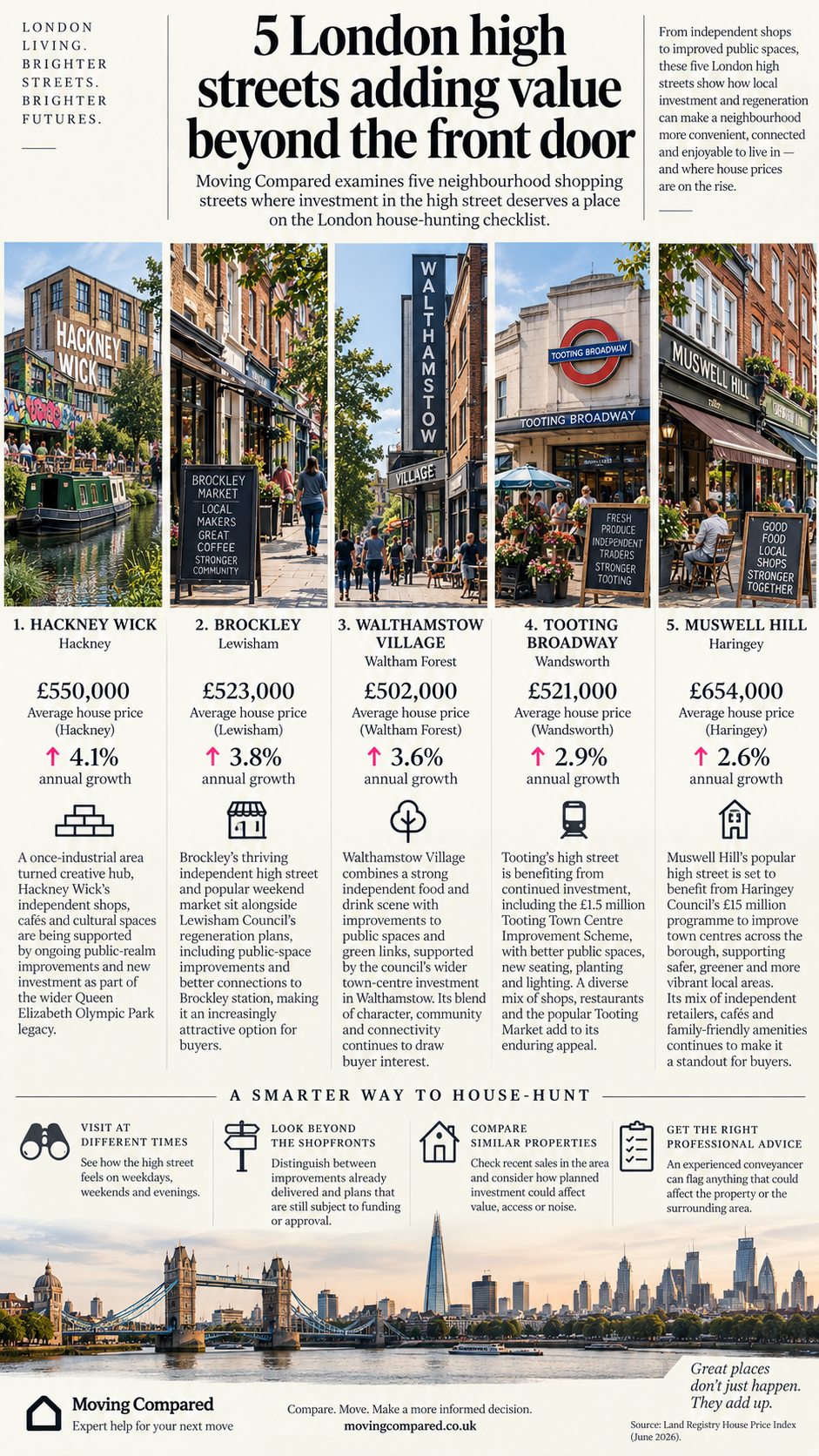
A good high street can be one of the things that sells a London neighbourhood before a buyer has even stepped through the front door, but cafés, boutiques and attractive shopfronts only tell part of the story. Across the five boroughs featured below, average house prices rose between 1.2% and 4.3% in the year to June 2026, giving house-hunters a reason to investigate the neighbourhood changes taking place alongside that growth.
Moving Compared, the UK home-moving hub helping buyers and sellers compare trusted conveyancers and surveyors, has examined five London high streets where restored buildings, new cultural destinations and investment in local businesses offer an alternative to the capital's more familiar village-style shopping streets. Each sits within a borough recording annual house-price growth, although the figures describe the wider borough rather than the individual neighbourhood.
What matters for buyers is understanding how much of that investment is already visible on the ground. Some improvements may already be shaping the look, feel and convenience of an area, while others remain longer-term ambitions. The five high streets below show how regeneration can take different forms, and what house-hunters may want to investigate when weighing up the wider appeal of a neighbourhood.
1. Tottenham High Road, Bruce Grove
Wider Haringey market: £634,000 average house price, up 2.5% annually.
Around Bruce Grove, the regeneration story is about making more of the architecture already there rather than replacing it with something new. Haringey's Tottenham High Street Heritage Action Zone brought together around £5 million for improvements including traditional shopfront repairs, heritage restoration and public spaces. Its focus on the High Road and Bruce Grove gives buyers a defined stretch of neighbourhood investment to explore, rather than a broad promise about Tottenham's future.
Among the more unusual transformations, the Grade II-listed former public conveniences, which fell out of use in the 1980s, have been restored as a community café and accessible public toilets. Restoration works at St Mark's Methodist Church were also completed in December 2025, adding another repaired landmark to the area.
For buyers, the attraction is the possibility of living near a high street whose existing character is being repaired rather than reinvented. Walk the route between a shortlisted property and the shops, looking at which restored premises are actively used and where further work remains. Buyers moving in or around Haringey can compare conveyancers through Moving Compared.
2. High Road Leytonstone, Waltham Forest
Wider borough market: £523,000 average house price, up 2.5% annually.
Leytonstone's opportunity is not simply to attract more people, but to make a busy high road somewhere they want to spend time. Waltham Forest Council reports around 6,000 pedestrians using High Road Leytonstone daily, alongside substantial road traffic. Its latest work on the street focuses on improving public spaces and making walking and cycling connections easier, with feedback from residents and businesses being assessed before the next steps are decided.
Some nearby improvements are already complete. Four junction upgrades and associated rain-garden work were delivered in April 2025 through the council's Business Low Emissions Neighbourhood programme, while other proposals remain in development. That creates a useful distinction for house-hunters between changes they can test on a viewing day and ambitions that should not yet be priced into a purchase. Try the walk from the property to the high road at a busy time, paying attention to crossings, traffic and the convenience of everyday shopping. Those considering a move can compare conveyancers serving Waltham Forest through Moving Compared.
3. Walworth Road, Southwark
Wider borough market: £582,000 average house price, up 2.2% annually.
Walworth's most interesting high-street change is about who might spend the working day there, not simply who moves into the surrounding homes. Following extensive restoration after the 2013 fire, Walworth Town Hall formally reopened in March 2025 with workspace capacity for more than 550 workers, alongside community space. The historic complex now combines flexible offices and coworking facilities, giving an established civic landmark a new commercial purpose.
A larger daytime working population could create more custom for nearby cafés, shops and services, although workspace capacity should not be mistaken for confirmed occupancy or measured spending. For buyers, the useful question is whether the surrounding high street works throughout the week rather than only during a weekend visit. Explore the streets around the town hall and compare the immediate surroundings of individual properties, particularly where other development is proposed. Buyers in the area can compare conveyancers serving Southwark through Moving Compared.
4. High Street, Sidcup, Bexley
Wider borough market: £405,000 average house price, up 1.2% annually.
Sidcup offers a different version of high-street renewal, with a library and cinema providing reasons to visit that do not depend on shopping. The Storyteller development replaced a long-derelict site with a library, three-screen cinema, café and homes. Contractor Neilcott lists the construction contract at £8.1 million, making this a substantial physical addition to the High Street rather than a programme of cosmetic improvements.
The cinema and café reopened under new operator Castle Cinema in December 2025 as Castle Sidcup, giving the development a fresh chapter. For prospective residents, the appeal is being able to build an ordinary day or evening around local facilities, rather than travelling elsewhere for every outing. Visit when a screening finishes as well as during daytime shopping hours, and check how comfortably the walk home fits around traffic, parking and the location of the property. Buyers considering the area can compare conveyancers serving Bexley through Moving Compared.
5. East Street, Barking
Wider Barking and Dagenham market: £371,000 average house price, up 4.3% annually.
Barking's emerging high-street story is about extending the trading day rather than simply adding more shops. A £100,000 Summer Streets grant supports plans for a food market at Short Blue Place, beside East Street, with six proposed container-style food stalls and outdoor seating. The intention is to give local food businesses another route to customers while creating a stronger evening destination in the town centre.
City Hall's programme lists cultural activity at Short Blue Place between August and December 2026, but buyers should distinguish the funded plans and event schedule from facilities that are already operating. Visit East Street during the day and return in the evening to assess what has opened and how the atmosphere changes. A livelier centre may appeal, but the right distance from food stalls, performances and evening activity will differ between households. Anyone moving in the area can compare conveyancers serving Barking and Dagenham through Moving Compared.
A spokesperson for Moving Compared said:
"London buyers often choose the neighbourhood almost as much as the property, and a strong local high street can be a big part of that decision. The important thing is to separate what is already there from what is being promised.
"Check what has actually been funded and delivered, look at planning and highways proposals around the property, and make sure your conveyancer understands anything that could affect the home or the streets immediately around it. A regeneration plan can be a positive sign, but it should never replace the usual due diligence."
For London buyers, that legal work is particularly important where flats, leasehold properties or complex developments are involved. Moving Compared notes in its London moving-cost guide that conveyancing in the capital can be more expensive because of higher property values and London's large proportion of leasehold homes. Buyers can also use its conveyancing comparison service to compare vetted firms matched to their move and location.
House-price figures are provisional June 2026 UK House Price Index borough averages, rounded to the nearest £1,000. Annual changes relate to the wider boroughs, not the featured streets, and do not establish that high-street investment caused prices to rise.
Contributor at The London News