The Last Analogue Process in Car Retail
AutoTalker CEO Andrew Wood explores the hidden staff and material costs of manual paper price cards and why dealerships are shifting to connected digital displa
5 October 2026 · 6 min read
By Andrew Wood, CEO & Founder of AutoTalker
When dealerships consider introducing new technology, the conversation usually starts with the cost of the technology itself. That's understandable; every investment needs to make financial sense. What can be overlooked, though, is the cost of the process that the technology is intended to replace. In vehicle retail, some of those costs sit within everyday tasks that have become so familiar that they're rarely calculated properly.
Take printed vehicle price cards. A member of staff might need to print a new card, check the information, take it outside, find the vehicle, remove the old card, and replace it with the new one. That might only take a few minutes at a time; across a forecourt with 100 vehicles, and with prices changing regularly, the hours can add up quickly. The same applies when finance information, specifications, promotional messages, or other vehicle details need to be changed.
Research published in 2025 found that UK dealer groups could save more than £1 million a year by automating car merchandising, after identifying 21 separate manual tasks involved in managing vehicles. The figure doesn't mean every dealership will have the same level of saving; the size of a dealer group, its stock levels, and the systems it already has in place will all affect the calculation. It does, however, give some indication of how much time can be tied up in vehicle merchandising.
The Hidden Operational Drain of Manual Forecourt Merchandising
Consider a dealership with 100 vehicles on site. If changing and checking a printed price card takes an average of five minutes per vehicle, updating the entire forecourt would take more than eight hours of staff time. If that happens twice a week, the process accounts for more than 16 hours every week. At an illustrative internal labour cost of £15 per hour, that's around £250 a week, or more than £13,000 a year, before printing costs are included.
The calculation doesn't stop with staff time. Paper, toner or ink, printer maintenance, discarded cards, and replacement materials all carry a cost; they're just less visible than a large technology purchase. There can also be administrative work involved in preparing revised information and checking that the right vehicles have received the right updates.
Multiple sites introduce another consideration: consistency. A price change affecting 300 vehicles could mean hundreds of physical updates, with someone needing to identify the affected vehicles, prepare the revised information, distribute it where necessary, and check that the old displays have been removed. A missed update can leave a vehicle showing an outdated price or finance example. Staff then have to correct the information, and customers may understandably question why the price they've seen on the vehicle doesn't match what they've found elsewhere.
That matters because customers are arriving at dealerships with more information than they had in the past. A buyer can research a vehicle online, compare it with similar stock, look at finance options, check specifications, and monitor prices before visiting the forecourt. When they arrive, they expect the information they see in person to make sense alongside what they've already found online. The physical dealership still has an important role in the buying process, but the information presented there forms part of a much wider digital journey.
Research supports the continued importance of the dealership itself. 72% of car buyers still prefer to complete their purchase at a dealership, while 52% of buyers are more likely to buy from a dealership when pricing is transparent and 42% expect pricing to be consistent between online listings and the forecourt. These figures don't mean customers have stopped using digital channels; they point towards a buying process where online research and physical visits increasingly overlap.
Bridging Physical Showrooms and Digital Omnichannel Journeys
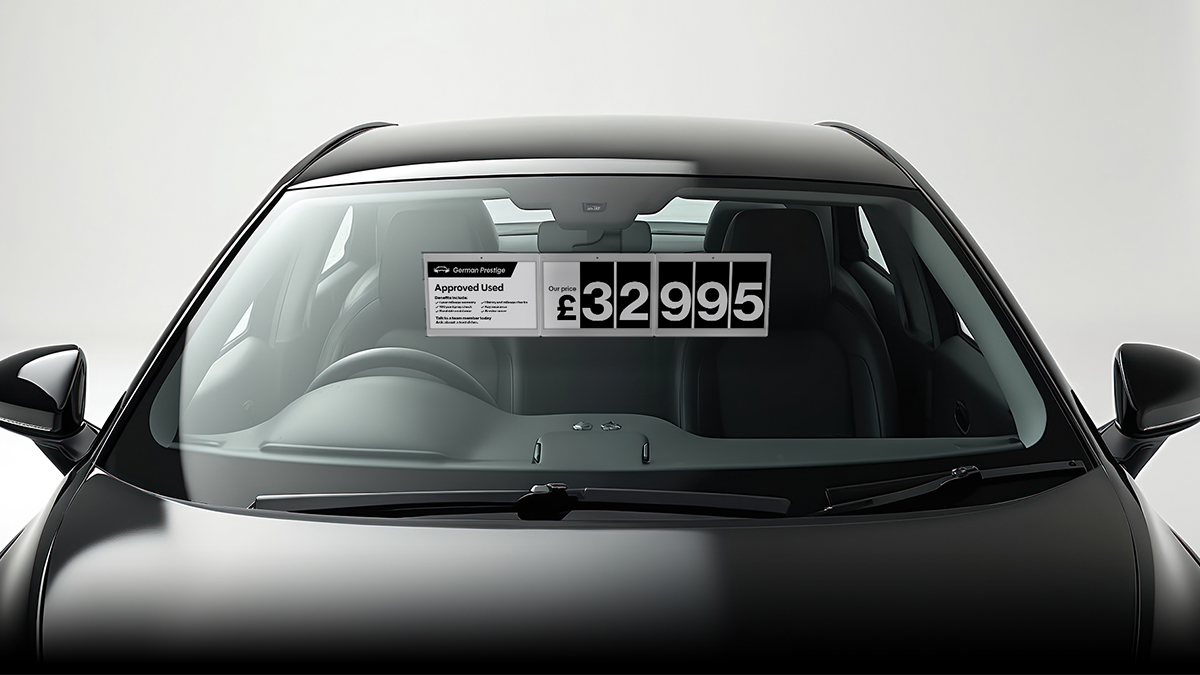
This is where digital vehicle displays are starting to change the way some dealerships manage information. Rather than producing a new physical card every time something changes, connected displays can receive information from a dealership's existing systems.
The important part of this process is the connection between the dealership's data and what's displayed on the vehicle. If a price is changed within the relevant system, a connected digital display can reflect that update without requiring someone to print a new card and walk around the forecourt replacing physical ones. The exact process depends on the systems a dealership is using and how they're connected. Digital displays therefore form part of a wider system rather than operating as an isolated piece of showroom equipment.
There are potential savings in that process, but dealerships need to calculate them against their own operations. The starting point is fairly straightforward: how many vehicles are being managed, how frequently does pricing change, how long do updates take, how much is being spent on printing materials, and how many employees are involved? It's also worth considering how much time is spent checking information and correcting mistakes after an update has been missed.
Staff time is particularly important because it has an opportunity cost. Someone spending an hour replacing price cards isn't spending that hour responding to enquiries, arranging test drives, following up with prospective buyers, or working with customers on the forecourt. That doesn't mean every minute saved by automation will translate directly into additional sales; it does mean dealerships should consider what their employees could be doing instead of repetitive administrative work.
The potential impact becomes more noticeable when stock is being repriced frequently. Used vehicle retailers may need to respond to changes in market values, ageing stock, or shifts in customer demand, while franchise dealerships may also be managing manufacturer campaigns and finance offers. Every change made through a paper-based process creates another physical task. A connected system can reduce the number of physical interventions required when those changes occur.
There are also longer-term considerations when assessing digital hardware. AutoTalker's e-ink displays are designed to operate for around 10 years, according to the company; that means the cost needs to be considered over the expected working life of the equipment rather than against the price of an individual printed card. Battery life, maintenance, replacement requirements, and the number of displays required will all affect the overall calculation. Those figures will vary between dealerships, so there isn't a single saving that can be applied across the industry.
The same principle applies when considering the wider cost of implementation. A dealership needs to account for the existing systems it uses, how much integration work is required, the number of vehicles covered, and how the technology will be managed over time. There may also be costs associated with replacing existing hardware or adapting established processes. Looking only at the purchase price can therefore give an incomplete picture of the investment.
For dealerships considering a move away from printed pricing, the useful question is less about the price of an individual digital display and more about the total cost of the existing process. That means adding up staff time, printing materials, repeated updates, error correction, and the administration involved in keeping information consistent. Once those figures are available, they can be compared with the costs of introducing and operating a digital system.
The wider change in vehicle retail is worth considering too. Customers aren't necessarily choosing between a digital buying journey and a physical dealership; increasingly, they're moving between the two. They might discover a vehicle online, check its price on a dealership website, visit the forecourt, scan a QR code for more information, and then return home before making a decision. The dealership therefore needs to keep information consistent across each stage of that journey.
Digital vehicle pricing is one response to that change. For some dealerships, the attraction will be the reduction in repetitive manual work; for others, it may be the ability to keep vehicle information consistent or make updates more quickly. The financial case will depend on how much a dealership currently spends maintaining its paper-based process and what it needs from a digital system. Those are practical questions that can be answered by looking at the dealership's own stock, processes, and costs.
The move towards digital displays shouldn't be assessed solely on whether the technology looks more modern on a forecourt. The more useful calculation is whether it changes the amount of time and money being spent on managing vehicle information. When a dealership understands what its current manual processes actually cost, it has a much clearer basis for deciding whether a change is worth considering.
Contributor at The London News